

On the Dash:
- Canada is dropping many retaliatory tariffs to match U.S. exemptions, ensuring over 85% of trade with the U.S. remains tariff-free.
- Canada retains tariffs on steel, aluminum, and autos while negotiating with the U.S., balancing industry protection with broader trade access.
- Prime Minister Carney frames the move as a tactical step to preserve Canada’s trade advantage and prepare for the USMCA review in 2026, despite domestic criticism from unions and opposition politicians.
Canada is dropping many of its retaliatory tariffs to match U.S. exemptions under the United States-Mexico-Canada trade pact (USMCA), Prime Minister Mark Carney announced Friday. The decision ensures that over 85% of Canadian trade with the U.S. remains tariff-free.
The move aligns Canada with carve-outs that shield most goods from punitive duties, while maintaining tariffs on steel, aluminum, and autos as negotiations continue with Washington. Carney emphasized the strategic nature of the adjustment, framing it as a way to preserve Canada’s trade advantage and set the stage for the USMCA review in 2026.
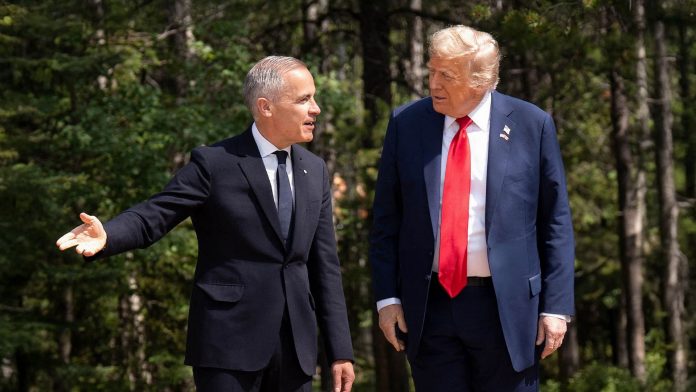
President Donald Trump praised discussions with Carney, noting the U.S. aims to protect its businesses while maintaining strong trade ties with Canada and Mexico. Carney and Trump spoke by phone on Thursday, followed by Carney’s Cabinet meeting on Friday before the announcement.
Some Canadian politicians and union leaders criticized the move. Lana Payne, president of Canada’s largest private-sector union Unifor, called it a capitulation, saying U.S. tariffs on sectors like autos, steel, aluminum, and forestry continue to harm Canadian workers. Opposition Conservative leader Pierre Poilievre also characterized the adjustment as yielding to U.S. pressure.
Canada initially imposed 25% tariffs on a range of American goods in March 2025, including oranges, alcohol, clothing, motorcycles, and cosmetics, in response to U.S. tariffs. Most imports from Canada and Mexico remain protected under the USMCA, which continues to play a critical role as more than 75% of Canada’s exports go to the U.S.
Carney stressed that Canada is not appeasing the U.S., noting the country is matching U.S. exemptions rather than extending additional concessions.
The tariff realignment balances the need to protect key domestic industries while maintaining broad access to the U.S. market, highlighting the ongoing strategic navigation of trade relations amid political debate.