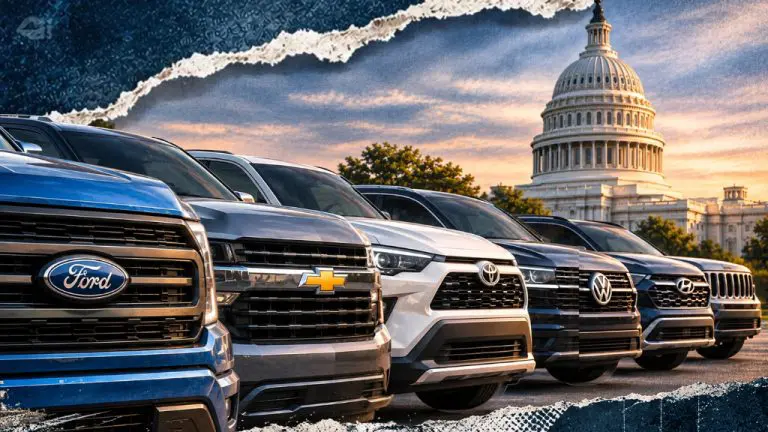
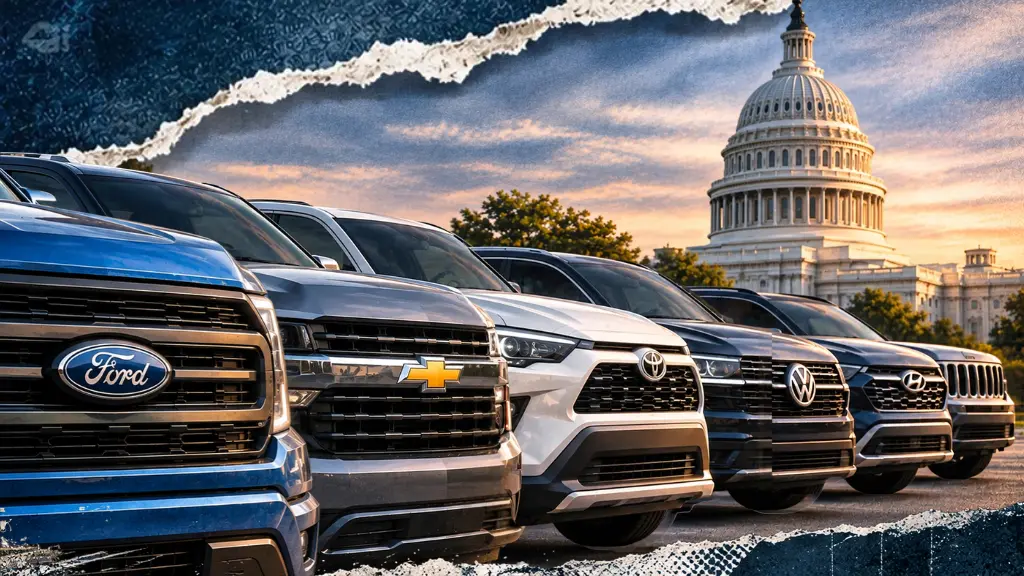
Something unusual just happened in the auto industry. General Motors, Ford, Toyota, Volkswagen, Hyundai and Stellantis are backing the Trump administration in a legal fight over fuel economy regulations. These companies compete against each other, but they share one major concern: Washington keeps changing the rules, and automakers are tired of planning billion-dollar investments around shifting political priorities.
The Alliance for Automotive Innovation recently told the First Circuit Court of Appeals that manufacturers need “certainty and stability” in federal fuel economy standards. The legal challenge, brought by California, New York and other states and local governments, could determine whether those governments can pursue their own approach instead of following federal rules.
The automakers say changing requirements affect capital investment, product development and validation for hundreds of vehicle models. That is a serious problem when designing a new vehicle can take years and manufacturers must commit to engines, transmissions, factories and suppliers long before a car reaches a dealership.
Washington keeps changing the rules
The Corporate Average Fuel Economy program, known as CAFE, began in 1975. Since then, administrations from both parties have changed the standards, leaving manufacturers to repeatedly adjust their engineering and product plans.
The Obama administration established more aggressive fuel economy and greenhouse-gas requirements. The first Trump administration revised portions of those rules, and the Biden administration raised the requirements again, setting a trajectory toward a 50.4-mpg fleet average by 2031. Now, the second Trump administration has reset the standards to a fleet-wide equivalent of approximately 34.9 mpg by 2031.
That is a substantial change. The Transportation Department estimates the revised standards will reduce manufacturers’ average compliance costs by approximately $1,289 per vehicle. But that does not mean every vehicle will become $1,289 cheaper. Automakers set prices based on production costs, competition, demand and profitability. Consumers need to watch whether those savings actually reach dealership window stickers.
Here is the bigger business problem: vehicle development does not operate on election cycles. Manufacturers need predictable rules to make long-term investments. When Washington repeatedly changes direction, companies must reconsider product strategies, engineering decisions and spending. Those costs can ultimately affect consumers.
Follow the money
There is another part of the CAFE system that rarely makes headlines: compliance credits. Under the previous program, manufacturers could earn credits by exceeding their applicable fuel economy requirements, and certain credits could be sold or transferred to other automakers.
Tesla has generated substantial revenue from regulatory credits, including credits from programs beyond CAFE. It is important to distinguish those separate systems. The new NHTSA rule ends intermanufacturer trading for CAFE credits earned beginning with model year 2028. That removes one compliance option and changes the financial equation for manufacturers that have relied on buying or selling those credits.
The EPA has also made a separate move. On February 12, 2026, Administrator Lee Zeldin announced the rescission of the 2009 greenhouse-gas Endangerment Finding and associated federal vehicle greenhouse-gas standards. That is a separate action from NHTSA’s CAFE rule. One concerns fuel economy requirements, the other concerns greenhouse-gas regulations.
Let consumers decide
Here is what gets lost in Washington’s argument: American drivers do not all want the same vehicle. Some need a truck that can tow, others want a fuel-efficient hybrid, a family SUV or a high-performance car. Some want an electric vehicle. They should all have that choice.
Why should every automaker be pushed toward the same technology strategy? Hybrid systems are improving because manufacturers see customer demand. Gasoline engines and transmissions continue to advance, and electric vehicles have a market for buyers who want them. Competition should determine which technologies succeed, not government officials trying to predict what millions of consumers should drive.
If someone wants a 777-horsepower Ram TRX, that should be their decision. If another buyer wants a Toyota hybrid or an electric Tesla, that should be their decision, too. The market should make room for all of them.
The administration says its revised standards will give manufacturers more flexibility and help make vehicles affordable. That claim deserves scrutiny. Lower compliance costs do not guarantee lower sticker prices, and consumers should hold automakers accountable for delivering real value.
The bigger question is whether the automotive industry can innovate, compete and build affordable vehicles without Washington repeatedly changing the rules and forcing manufacturers to redirect billions in investment. Consumers deserve choices, honest pricing and vehicles that meet their needs.
Build what people want to buy, at prices they can afford. Let automakers compete on technology, quality, performance and value. That should not be a radical idea.
Check out my full commentary on this story: https://youtu.be/06GiOBoefa4
Looking for more automotive news? https://www.CarCoachReports.com
Listen and subscribe to The Drive with Lauren and Karl – https://www.youtube.com/@thedrivecarshow