Welcome back to the latest episode of The Future of Automotive on CBT News, where we put recent automotive and mobility news into the context of the broader themes impacting the industry.
I’m Steve Greenfield from Automotive Ventures, and I’m glad that you could join us.
One of the great innovations in manufacturing over the past decades has been lean six sigma and just-in-time delivery.
But if anything, the fact that we’ve dialed in the supply chain so tightly, has left very little to no flexibility if and when we need it. This truth may be most evident in the world of vehicle manufacturing.
During COVID, the supply chain shock created a shortage of microchips, which then had the unintended consequence of a shortage of new vehicles. Since then, we’ve seen wave after wave of supply chain issues affecting automakers.
Automakers felt this in specialized aluminum, when factory fires at key suppliers—such as multiple blazes at Novelis’s aluminum rolling facility in Oswego, New York—severely constrained wide aluminum sheet production, costing Ford an estimated $1.5 billion in temporary headwinds and impacting high-margin F-Series truck volumes.
Automakers felt this through regional natural disasters, experiencing earthquakes and severe weather events in manufacturing-heavy regions like Japan that have repeatedly forced temporary shutdowns across plants run by Toyota, Nissan, and Honda due to localized supplier parts halts.
We’ve felt this recently with geopolitical and tariff pressures, where broad international trade disputes and soaring duties on steel, aluminum, and EV battery components have added billions in cumulative compliance and material costs, prompting sudden shifts in localized sourcing.
Automakers have felt supply chain pressures across logistics and freight bottlenecks, experiencing ongoing volatility across rail, maritime shipping, and trucking networks continues to cause unpredictable delivery delays, leaving assembly lines vulnerable to sudden inventory gaps.
And finally, the geopolitical tensions with China have recently mounted, a former trade partner who has locked up many of the critical resources needed to produce electronics and EV batteries, resulting in global automakers more at risk than ever for manufacturing inputs such as rare earth minerals.
So how are automakers compensating for this new world, to work to insulate their operations from future supply chain shocks?
Well, the best example may be General Motors, who clearly has a strategy to do so.
You might remember back to the end of 2024, when General Motors invested $625 million to form a 38% asset-level joint venture with Lithium Americas for the Thacker Pass lithium mining project in Nevada.
Thacker Pass is a major lithium clay mining development project located in the McDermitt Caldera of northern Nevada. It holds the largest known measured lithium resource in the United States and is a central focus for domestic electric vehicle supply chains and clean-energy independence.
Fast forward to this week, and news that General Motors is setting up a $4.5 billion safety net designed to keep critical components flowing through their supply-chain.
The automaker aims to avoid future parts crunches by securing supplies of high-risk components through a financing arrangement where it pre-funds the purchase of essential parts.
The move aims to give suppliers enough capital to maintain production and potentially stockpile parts. GM in turn can keep its assembly lines moving amid supply-chain disruptions, without tying up large amounts of capital.
GM Chief Executive Mary Barra has pledged to remake GM’s supply chain and create a system more capable of managing disruptions. The post-pandemic semiconductor shortage cost GM billions as the automaker was forced to sporadically idle assembly plants across North America.
Under this new deal, supply-chain management firm Procura will receive funding through a bank syndicate led by JPMorgan Chase and Santander. Procura will prepay certain suppliers on GM’s behalf, giving them capital required to make and store inventory set aside for the Detroit automaker.
GM said the deal aims to lock down parts in the event of a range of events, from cyberattacks to demand spikes to natural disasters.
The substantial commitment underscores GM’s push to avoid a repeat of the severe shortages that have dogged the industry in recent years.
I expect other automakers will take the lead from GM, and start taking similar creative steps to help their suppliers, and insulate against possible future disruptions to their supply chains.
So, with that, let’s transition to Our Companies to Watch.
Every week we highlight interesting companies in the automotive technology space to keep an eye on. If you read my weekly Intel Report, we showcase a company to watch, and take the opportunity here on this segment each week to share that company with you.
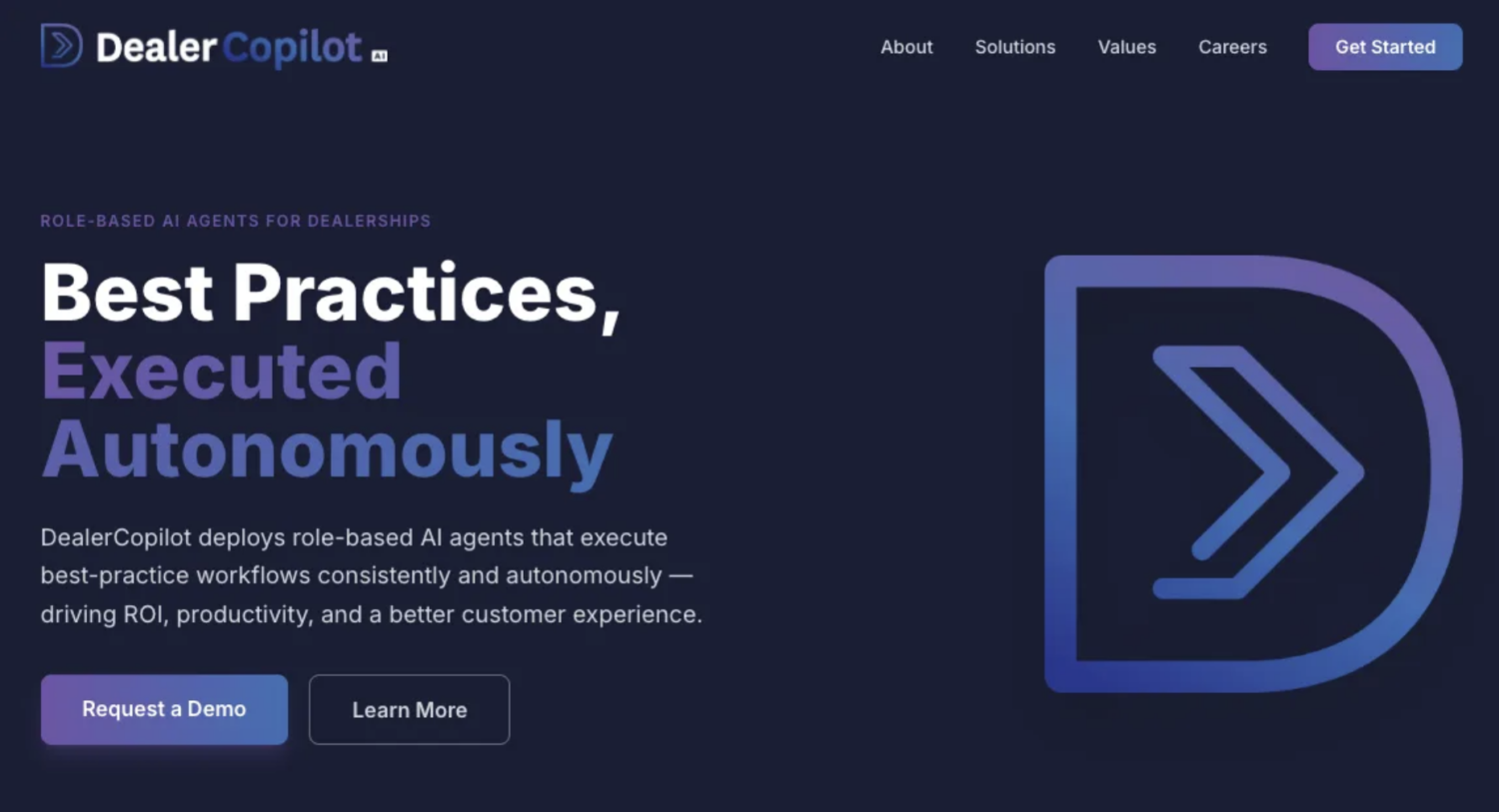
Today, our new company to watch is DealerCopilot.
DealerCopilot is a brand new AI-powered solution for automotive dealers.
DealerCopilot deploys role-based AI agents that execute best-practice workflows consistently and autonomously — driving ROI, productivity, and a better customer experience.
Dealerships are drowning in data, juggling dozens of tools, and asking their teams to do more with less. Best practices exist — but consistent execution is the hard part.
DealerCopilot provides AI agents purpose-built for dealership operations — removing friction, enforcing consistency, and delivering measurable results from the service drive to the front office.
If you’d like to learn more about DealerCopilot, you can check them out at: www.DealerCopilot.ai
So that’s it for this week’s Future of Automotive segment.
If you’re an AutoTech entrepreneur working on a solution that helps car dealerships, we want to hear from you. We are actively investing out of our new Mobility Fund.
Don’t forget to check out my two books, The Future of Automotive Retail and The Future of Mobility, both available on Amazon.com.
Thanks (as always) for your ongoing support and for tuning into CBT News for this week’s Future of Automotive segment. We’ll see you next week!