There’s enforcing the law—and then there’s building a system that treats every driver like a suspect the moment they turn the key. Colorado isn’t flirting with that line anymore. It’s driving straight past it.
For years, speed cameras were a minor annoyance. You knew where they were, your navigation app warned you, and if you were paying attention, you adjusted. It wasn’t perfect, but at least it was transparent. Colorado has now scrapped that model in favor of something far more aggressive—and far less accountable.
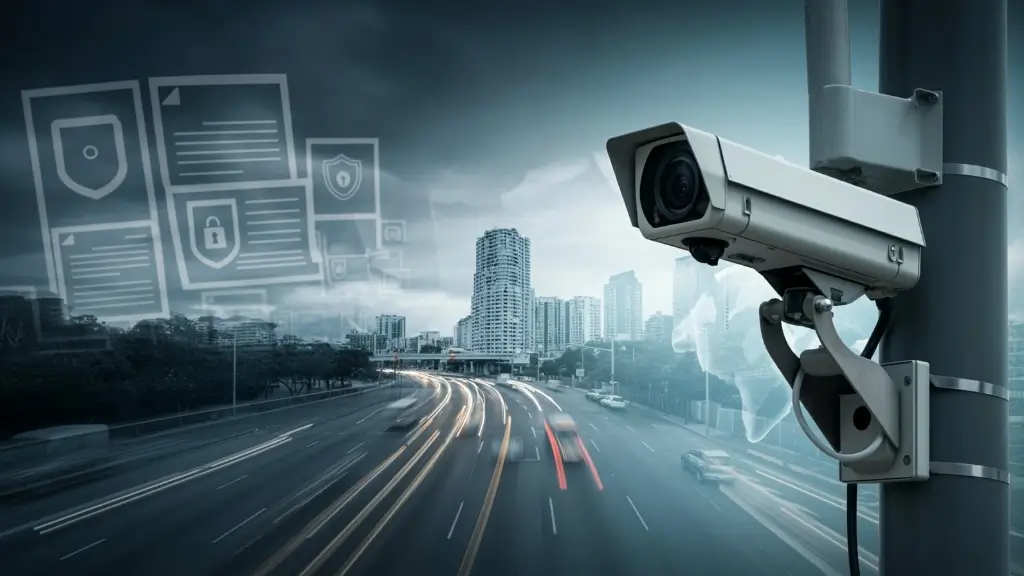
The state’s new Automated Vehicle Identification Systems (AVIS) don’t just clock your speed at a single point. They track your vehicle across multiple cameras, calculate your average speed over distance, and automatically issue a ticket if you’re 10 miles per hour or more over the limit. No warning. No discretion. No human judgment. Just a system quietly watching, calculating, and penalizing.
Let’s call this what it is: not smarter enforcement, but broader surveillance.
The rollout followed a 2023 change in state law, and what started as warnings has quickly turned into active ticketing. One of the newest stretches under this system is Interstate 25 north of Denver, where drivers moving through construction zones are now monitored continuously. The state says it’s about safety. That’s the headline. But the fine print tells a different story.
The penalty is $75 and carries zero points on your license. That’s not an accident. If this were truly about cracking down on dangerous driving, there would be meaningful consequences tied to your driving record. Instead, this looks like a volume business model—low enough fines to keep people from fighting, high enough frequency to generate serious revenue.
And then there’s the part that should concern every driver in America: the ticket goes to the registered owner of the vehicle, not necessarily the person who was driving.
That’s where this stops being about traffic enforcement and starts colliding with the Constitution.
The burden of proof in this country is supposed to be on the state. That’s not optional. That’s foundational. Yet Colorado’s system leans on the assumption that if your name is on the registration, you’re responsible—unless you can prove otherwise. That flips due process on its head.
Colorado Revised Statute 42-4-110.5 does not give the state a blank check to assign liability to vehicle owners in every situation. In fact, it explicitly acknowledges that the owner may not have been the driver. And long-standing legal precedent—at both the federal and state level—makes it clear that the government must prove its case beyond a reasonable doubt.
Relying on a license plate and a database isn’t proof. It’s a shortcut.
And let’s be honest: the system counts on the fact that most people won’t push back. They’ll see the fine, weigh the hassle of fighting it, and just pay up. That’s not justice. That’s compliance by inconvenience.
If you do challenge it, you’re stepping into a legal maze that most drivers aren’t equipped to navigate. Meanwhile, the state continues issuing tickets at scale, backed by a system that never sleeps, never questions itself, and never exercises judgment.
This is what happens when enforcement becomes automated. Accountability disappears.
A police officer can assess a situation. A camera cannot. It doesn’t care if traffic flow made it safer to keep pace. It doesn’t account for conditions. It doesn’t apply discretion. It simply records, calculates, and penalizes. That might be efficient, but it’s not fair—and it’s certainly not nuanced.
Then there’s the bigger picture, the one few officials seem eager to talk about.
These systems don’t just measure speed. They track movement. They log where your vehicle enters a zone, where it exits, and how it behaves in between. Expand that across highways, cities, and eventually entire states, and you’re looking at a real-time network that monitors how Americans move.
And if you think it stops at speeding, you haven’t been paying attention to how quickly technology evolves.
Today it’s average speed enforcement. Tomorrow it could be automated citations for rolling stops, lane usage, or anything else that can be digitized. Add artificial intelligence into the mix, and the potential scope grows exponentially. This isn’t science fiction—it’s the natural progression of a system that’s already in place.
Colorado isn’t just testing a traffic tool. It’s piloting a framework.
Supporters will argue this is about protecting construction workers, and that’s a legitimate concern. No one is arguing against safety. But safety cannot become the catch-all justification for systems that erode fundamental legal protections. You don’t preserve public safety by undermining due process.
And let’s not ignore the tone coming from officials who promote these programs. There’s an almost casual acceptance—sometimes even pride—in the idea of constant monitoring. As if a 24/7 enforcement net is something drivers should simply accept as the cost of modern transportation.
That’s not how this is supposed to work.
Government answers to the people, not the other way around. Policies like this deserve scrutiny, debate, and—when necessary—pushback. Because once a system like this is normalized, it doesn’t get scaled back. It expands. Quietly. Incrementally. Permanently.
Colorado may frame this as innovation. But from behind the wheel, it looks a lot more like overreach.
And if other states decide to follow this blueprint—and they will—drivers across the country may soon find themselves in the same position: tracked, ticketed, and told to prove their innocence after the fact.
That’s not better enforcement.
That’s a fundamental shift in how the rules are applied—and who they’re really serving.
Check out my full commentary on this story: https://youtu.be/7lUrpK9hCDo
Looking for more automotive news? https://www.CarCoachReports.