


Welcome back to the latest episode of The Future of Automotive on CBT News, where we put recent automotive and mobility news into the context of the broader themes impacting the industry.
I’m Steve Greenfield from Automotive Ventures, and I’m glad that you could join us this week.
This week, we’re looking at an industry at a crossroads — the global auto business. For decades, carmakers have been able to count on one thing: sell enough internal combustion engines, and the business takes care of itself. But that model is now unraveling, faster than most executives ever imagined.
The reason? Electric vehicles. And more specifically, electric vehicles coming out of China — cheaper, more advanced, and arriving on global markets at a pace that’s caught many traditional carmakers completely off guard.
Now, you’d think that with years of warning, the giants of the industry — General Motors, Volkswagen, Toyota, Ford — would have been ready. But here’s the truth: most don’t have a strategy for this new reality. And that’s a problem when it takes four to five years just to bring a new model to market. By the time a car finally rolls off the line, consumer demand, government policies, and the competitive landscape may all have shifted dramatically.
Look at what Porsche’s CEO told employees in July. In a blunt internal memo, he admitted, “Our business model, which has served us well for many decades, no longer works in its current form.” That kind of honesty is rare in this industry — but it speaks to just how deep the uncertainty runs.
For a brief window, between 2021 and 2023, automakers thought they had cracked the code. Profits soared to near-record levels. Companies hired thousands of software engineers. They talked about ending dealership contracts, selling directly to consumers, and replacing combustion engines with sleek new EVs. On paper, it looked like a transformation was underway.
But much of that profit boom wasn’t real innovation. It was the chip shortage. With fewer cars available, prices skyrocketed, and margins swelled. Once the shortage eased, the underlying challenges became impossible to ignore. EV sales grew — but unevenly. Software proved far more complicated than expected. And when carmakers tried to charge customers for upgrades like heated seats or faster acceleration, the backlash was immediate.
Meanwhile, China’s automakers were making quiet, steady progress. Today, Chinese companies control nearly two-thirds of their own market, up from just 41 percent a few years ago. They’re exporting cars aggressively — five percent of sales in Europe, ten percent in Latin America, and growing. Western automakers who once saw China as their most important growth engine are now losing ground.
Ford’s CEO, Jim Farley, put it plainly: “It’s the most humbling thing I’ve ever seen. The cost and quality of their electric vehicles is far superior to what I see in the West.”
And it’s not just about cars. China dominates the EV battery supply chain. In fact, in many cases, the battery now costs as much as the rest of the car combined. Whoever controls battery production controls the future of this industry.
Western automakers once dreamed of turning cars into software platforms — selling features and services long after the initial purchase, the way Apple monetizes the iPhone. But that vision is colliding with reality. Customers don’t want to pay for things they feel should be included. And Chinese companies like BYD are pushing the opposite approach, bundling features for free to win loyalty. That undercuts the very business model Western automakers have been betting on.
Still, companies like Ford are trying to carve out a path. They’ve had some success with their “Ford Pro” business, selling software subscriptions to commercial fleet customers — people who can’t afford downtime because every hour their trucks aren’t running is lost revenue. Ford believes those lessons will eventually translate to consumer markets.
But even that may not be enough. Dealers, the backbone of the traditional sales system, make their money on servicing cars. Electric vehicles require far less service, which upends that profit model. And while plug-in hybrids offer a temporary reprieve — with higher prices and more parts to maintain — they’re not a long-term solution.
So what’s next? Some, like Volkswagen, are trying to take battery production in-house. Ford is investing billions to reinvent the way it builds electric vehicles, with a bold plan to bring a $30,000 electric pickup to market by 2027. But that’s still years away.
And all the while, consumer demand for EVs remains inconsistent. Government subsidies that once boosted sales are starting to fade. Automakers are stuck straddling two worlds — developing new electric platforms while still pouring resources into combustion engines. It’s a balancing act that stretches budgets thin and leaves companies vulnerable.
What becomes clear, the deeper you look, is that there’s no single winning strategy right now. Every automaker is scrambling, trying to outrun rivals, hoping their plan works before the ground shifts again.
But what is clear is this: the old playbook is gone. The auto industry isn’t just competing to sell cars anymore — it’s competing to define the very future of mobility, and whether it can survive in a world that may soon be dominated by China.
At stake, for some of the biggest names in global business, isn’t just market share. It’s survival.
So, with that, let’s transition to Our Companies to Watch.
Every week we highlight an interesting company in the automotive technology space to keep an eye on. If you read my weekly Intel Report, we showcase a company to watch, and we then take the opportunity here on this segment each week to share that company with you.
Today, our new company to watch is Wrapmate.
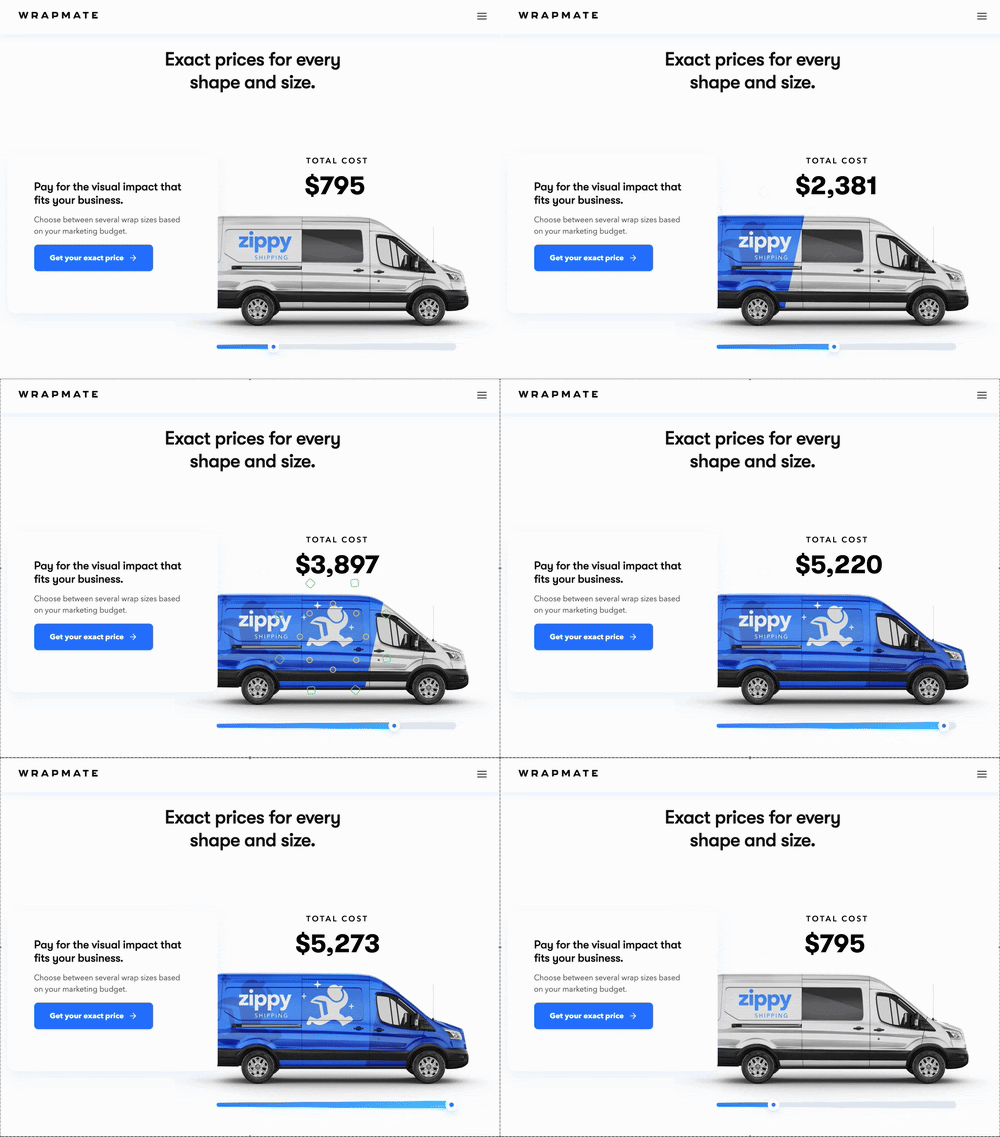
Wrapmate began with the idea that vehicle graphics should be accessible to anyone, anywhere, and based on any budget. Their approach to bringing these graphics to life, along with their industry knowledge and expertise, gives you a world-class experience you won’t find anywhere else.
Wrapmate has simplified the experience into three easy steps:
Step 1: Get your price. Receive a final cost in just a few clicks and compare different size options and prices that meet your needs.
Step 2: Get your design. Select your custom design package and our design team will create something you’ll love.
Step 3: Get your wrap. No matter where you’re located, a Wrapmate Pro can install your vehicle wrap to perfection.
If you’d like to learn more about Wrapmate, you can check them out at www.WrapMate.com
So that’s it for this week’s Future of Automotive segment.
If you’re an AutoTech entrepreneur working on a solution that helps car dealerships, we want to hear from you. We are actively investing out of our DealerFund.
Don’t forget to check out my first book, “The Future of Automotive Retail,” and my new book, “The Future of Mobility”, both of which are available on Amazon.
Thanks (as always) for your ongoing support and for tuning into CBT News for this week’s Future of Automotive segment. We’ll see you next week!