
Investing in a memorable service department experience helps create a profitable, lifetime customer . BY CHUCK DE MARTIGNY
Your dealership spends considerable time, effort and money to attract customers and close the sale. Are you creating a memorable service department? According to NADA data, in 2014 advertising expenditures alone were $606 per vehicle.
Even though prospects remain strong for unit sales, the marketplace appears even more competitive than last year, putting further pressure on margin. No wonder dealership management is fixated on the sales funnel, i.e. all the factors that influence a consumer’s buying decision. But, are you really looking at the whole picture?
The same customers to whom you’ve devoted all of the energy and resources on the new vehicle increasingly go elsewhere for service as the vehicles age and the warranty expires. NADA data for 2014 show that OEM car dealerships generate $45.4 million of customer pay service and parts revenue, which is only 21% of a $215 billion consumer market. This means that 79% of the service work is going somewhere else.
With only a 21 percent share of service revenue, dealers are losing more than half their customers in the first three years of ownership. The 8 percent share of replacement tires means only 17.4 percent of OEM dealer customers buy replacement tires at the dealership.
A key trigger to service defections is purchases of replacement tires, and auto dealerships only enjoyed 8.0 percent of that U.S. market last year, according to Modern Tire Dealer. In contrast, independent tire dealers had 60.5 percent of sales. Even warehouse retailers outperformed dealerships, with 9.0 percent. Compare the numbers of the replacement tire market with the total service market. A large percentage of your customers leave to buy tires, and most of them never come back.
Stats Don’t Lie About Service Clients
Apart from service revenue’s importance to your bottom line, these customers also represent your best prospects for future new vehicle purchases. Jim Phillips, director of custom education delivery at the NADA Dealer Academy, shared one major manufacturer’s survey at a presentation at this year’s NADA convention that correlates the frequency of service visits with repeat purchases:
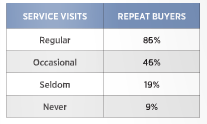
So, what do all these numbers have to do with the sales funnel? Every two service customers you lose cost you a car sale! At an average customer acquisition cost of $606, it will cost you $303 to replace each customer you lose. Plus, each customer you lose also costs you $1,400 in lost service revenue!
According to a recent Omnibus, Harris Interactive Survey on behalf of Cars.com, 64 percent of in-market buyers indicate that a service department’s reputation is a factor when choosing where to buy. Furthermore, the research revealed that 57 percent of shoppers sought out a dealership’s service department reviews before purchasing a car.
Service Drive Needs Innovation
Bottom line: it’s time to invest in your service department. With the focus on new car sales, dealerships are not spending the time and money to make the service department a destination with compelling point-of-sale displays, exciting product selections, up-to-date signage, and all the other retail accouterments that today’s savvy shopper expects – especially women, who represent more than 50 percent of the clientele. Is it any wonder that a significant number of new customers don’t even turn up for their first service appointment?
This is only the tip of a huge iceberg, representing either a potential disaster or a huge opportunity. Happy customers write good reviews and build reputation. Lost customers don’t.
With that said, here are some approaches to consider that can help transform your service drive from drudgery for the customer into a destination:
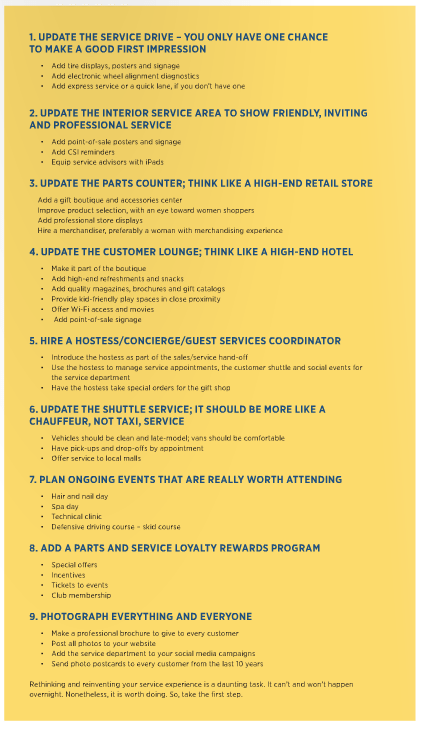
Rethinking and reinventing your service experience is a daunting task. It can’t and won’t happen overnight. Nonetheless, it is worth doing. So, take the first step.