Hyundai chose the Manhattan skyline as the backdrop for the global reveal of its all-new 2027 Tucson, and the message was clear: this is not just an update to one of Hyundai’s best-selling SUVs. The new Tucson is designed to push the model further into the mainstream with more space, new hybrid technology, a dramatically upgraded digital experience and, for the first time, a serious off-road-focused XRT PRO.
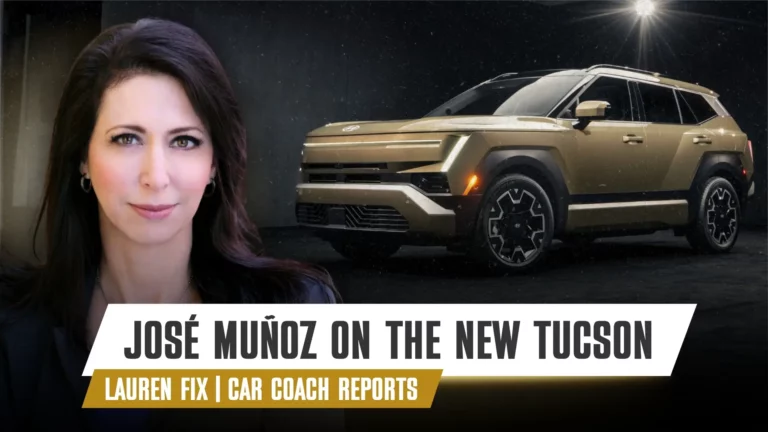
I was in New York for the reveal and had the opportunity to interview José Muñoz, President and CEO of Hyundai Motor Company, about where Tucson fits into Hyundai’s larger strategy. His focus was on giving customers more capability and technology without losing the everyday usability that has made Tucson such an important vehicle for the brand.
Hyundai calls the design philosophy “Art of Steel,” and you can see why. The new Tucson has a more muscular stance, with pronounced fenders, sharper body lines and a wider, more planted appearance. It is longer, wider and taller than the outgoing model, giving it a more substantial presence while also creating additional room inside.
The long-wheelbase version grows by about 2.4 inches in length, 1.6 inches in width and 0.8 inch in height. Those numbers may not sound dramatic, but together they make the Tucson look and feel considerably more substantial.
Hyundai also paid attention to something as simple as getting in and out. The door opening angle increases from 73 to 83 degrees, making access easier, while the front-end design has been engineered with pedestrian protection in mind.
Inside, the Tucson takes another major step forward. The cabin is cleaner and more spacious, with intuitive controls, flexible storage and available comfort features designed around everyday use.
But the biggest technology story is Hyundai’s new Pleos Connect infotainment system.
Depending on the configuration, Tucson will offer a 17-inch or 12.9-inch primary display along with a 9.9-inch slim display. The system is built on Android Automotive OS, allowing Hyundai to integrate applications and services directly into the vehicle rather than relying entirely on smartphone mirroring.
That becomes particularly interesting with Gleo AI, Hyundai’s new in-vehicle artificial intelligence system.
Instead of navigating through multiple menus, drivers can use natural language to ask the vehicle for information or assistance. For example, you could ask the system to find a hiking trailhead with parking within 30 minutes, and the system is designed to understand the context of the request and provide an appropriate answer.
That is where automotive technology is heading. The goal is no longer simply putting a larger screen in the dashboard. It is making the technology easier to use while reducing the amount of time drivers spend interacting with that screen.
Pleos Connect will also support over-the-air updates, allowing the system to evolve after the vehicle leaves the dealership.
Under the hood, Hyundai is putting additional emphasis on hybrid efficiency. The next-generation hybrid system is targeting up to 42 mpg, while also being engineered to provide a better balance between fuel economy and performance.
That is an important move because the market has changed dramatically. Consumers want better fuel economy, but many are not ready to give up the convenience and flexibility of a gasoline-powered vehicle. Hybrids offer a middle ground, and Hyundai is clearly betting that demand will continue to grow.
Then there is the Tucson XRT PRO.
This is the version that caught my attention because Hyundai is taking the XRT formula considerably further. The XRT PRO gets all-wheel drive, all-terrain tires, increased ground clearance, more aggressive approach and departure angles, front recovery hooks and additional lower-body protection.
Ground clearance increases to approximately 8.3 inches, about 1.2 inches more than the standard Tucson. The exterior also gets a more rugged appearance, including expanded cladding and distinctive wheel designs wrapped in all-terrain rubber.
Hyundai is also introducing Smart Terrain Assist, its first application of the technology, designed to help drivers manage different off-road conditions.
That doesn’t mean the Tucson XRT PRO suddenly becomes a rock-crawling Jeep Wrangler competitor. But it does show Hyundai responding to customers who want an SUV that can handle more than a suburban commute without moving into a much larger and more expensive vehicle.
And there is another important detail for American buyers: the 2027 Hyundai Tucson will be built in America. Hyundai plans to manufacture the U.S.-market Tucson at Hyundai Motor Manufacturing Alabama in Montgomery, Alabama. That puts the Tucson among the growing number of Hyundai vehicles benefiting from the company’s expanding American manufacturing footprint.
The all-new Tucson launches first in Korea later this year, followed by North America, Europe and other global markets in 2027.
The Tucson has become a critical vehicle for Hyundai, and this new generation shows just how much the company believes the SUV market is changing. Buyers want efficiency, but they also want performance. They want advanced technology, but they don’t want technology to become complicated. And increasingly, they want an SUV that can handle a weekend adventure as easily as it handles Monday morning traffic.
Hyundai’s answer is a Tucson that is bigger, smarter and more capable, while still staying firmly in the mainstream SUV category.
After seeing the vehicle in person and speaking with José Muñoz, one thing is clear: Hyundai isn’t treating Tucson as just another model in its lineup. It sees this SUV as a major part of where the company is going next.
Lauren Fix, The Car Coach®, is a nationally recognized automotive expert, analyst, and consumer advocate. You’ve seen her on television, radio, and across digital platforms, breaking down the latest in automotive news and reviews. For more updates and expert insight, follow Lauren at The Car Coach Reports.
Listen to The Drive Car Show – https://www.youtube.com/@thedrivecarshow