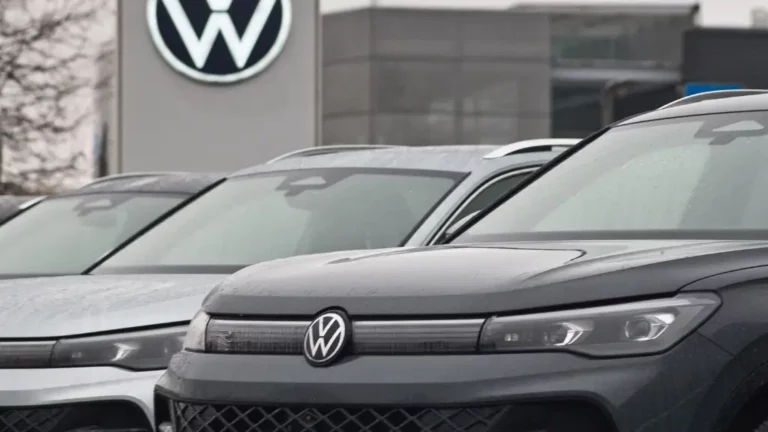
For years, automakers and policymakers pushed a narrative that the future of the auto industry was clear, inevitable, and electric. That narrative is now colliding with reality. The latest financial results from Volkswagen Group expose what happens when aggressive strategy outpaces consumer demand, global markets shift, and policy-driven timelines fail to align with economic truth. The impact is huge to one of the largest global automakers.
Volkswagen sold just over 9 million vehicles last year, only a slight dip from the previous year. Revenue remained massive at roughly $350 billion. On the surface, that suggests stability. But underneath, the numbers tell a different story. Operating profit was cut by more than half, and net profit dropped over 44%. That kind of decline is not cyclical noise. It reflects deep structural pressure across the business. This was caused by more than EVs, part of the cause is Chinese vehicles.
The company is not expecting a quick rebound. For a global automaker of this scale, stagnation is a warning sign. Volkswagen Group includes, VW, Audi, Porsche, Bentley, Lamborghini, Bugatti, Ducati, Skoda, Seat and Cupra.
At the center of the problem is Porsche AG, the brand that has long served as Volkswagen’s financial engine. Porsche has historically delivered industry-leading profits, often far exceeding those of mass-market competitors. That advantage has now eroded at a pace few expected.
In 2025, Porsche recorded approximately $4.2 billion in extraordinary charges, that’s a drop in profit by 98%, that is huge. While these are not traditional cash losses, they represent a significant shift in how the company values its future. Its time for some big changes for this performance car company.
The primary driver behind these losses is Porsche’s commitment to an all-electric future, investing years and billions into a next-generation EV platform and walking away from gas-powered sports cars. That EV plan has now been abandoned. The company is pivoting back toward internal combustion engines and plug-in hybrids, this is a smart move, this is what their customers want.
This shift comes at a cost. Investments that were once expected to generate long-term returns are now being written off. Porsche also reduced the projected value of its brand and future earnings through a goodwill impairment, signaling lower confidence in long-term profitability tied to its previous strategy.
Operational performance reinforces the concern. Porsche deliveries dropped more than 10% to roughly 279,000 vehicles. Sales fell 15%, and revenue declined nearly 12% to about $35 billion. The company is also losing ground in China, a market that was expected to drive growth but is now dominated by domestic manufacturers offering competitive technology at lower prices.
The electric vehicle segment has proven particularly challenging. The Porsche Taycan, once positioned as a flagship EV, saw deliveries fall 22%. This reflects broader hesitation among consumers, especially in the premium segment, where expectations for performance, infrastructure, and value remain high.
At the same time, tariffs are adding another layer of pressure. In the United States, increased import costs are squeezing margins and complicating pricing strategies. Combined with geopolitical uncertainty and trade barriers, these factors are creating an increasingly difficult environment for European automakers.
The impact on Volkswagen is significant. The group relies on high-margin brands like Porsche to offset weaker performance elsewhere. When Porsche’s operating margin collapsed from 14.5% to just 0.3% in a single year, it removed one of the company’s most important sources of profitability.
The response has been swift and severe. Volkswagen plans to cut 50,000 jobs in Germany by 2030, expanding on earlier workforce reductions. Porsche itself is eliminating nearly 4,000 positions. These moves reflect a broader effort to reduce costs and adapt to changing market conditions.
This is not an isolated issue. It highlights a larger shift across the European auto industry. The transition to electric vehicles is no longer being treated as a one-directional path. Automakers are reassessing timelines, scaling back investments, and reintroducing internal combustion options to align with actual consumer demand.
Porsche’s leadership is now focusing on high-margin products, including traditional gasoline-powered vehicles, to restore profitability. This approach may stabilize the brand in the near term, but it also underscores the uncertainty surrounding long-term strategy.
The broader implications are difficult to ignore. If Porsche, with its strong brand, loyal customer base, and historically high margins, struggles to make electric vehicles profitable, the challenge becomes even greater for other manufacturers operating with tighter margins and less flexibility.
Competition from China is accelerating this pressure. Domestic automakers are advancing rapidly in battery technology, software, and cost efficiency, often delivering vehicles that match or exceed European offerings at lower prices. This shift is reshaping global competition in real time.
Volkswagen’s current situation is being compared to its 2015 diesel emissions crisis, which resulted in more than $30 billion in penalties and settlements. The difference now is that today’s challenges are not tied to a single event. They are rooted in long-term changes to technology, regulation, and consumer behavior.
Despite these challenges, there are still strengths within the organization. Porsche maintains strong brand equity and pricing power, and its financial position includes roughly $4 billion in net liquidity. Volkswagen continues to pursue cost efficiencies and leverage its scale across multiple brands.
But those strengths do not eliminate the underlying issue. The assumptions that guided the industry over the past decade are being tested. Rapid EV adoption, stable global trade, and predictable growth are no longer guaranteed.
What emerges from Volkswagen’s latest results is a clear message. Strategy must align with reality. Consumer demand, infrastructure readiness, and economic conditions cannot be ignored or accelerated through policy alone.
The global auto industry is entering a period of recalibration. Companies that adapt quickly and make disciplined decisions will be better positioned to navigate the transition. Those that rely on outdated assumptions risk falling further behind.
Volkswagen’s numbers are more than a financial update. They are a signal of where the industry stands—and where it may be headed next. Customers will buy what they want not what the government tells them to buy.
Check out my full commentary on this story: https://youtu.be/W3KaA3EyDc4