TSLA342.2702.31%
GM86.7700.38%
F14.3650.475%
RIVN15.360-0.46%
CYD45.240-0.32%
HMC31.5800.38%
TM191.1102.4%
CVNA75.6201.92%
PAG219.8501.18%
LAD377.550-1.10999%
AN209.4101%
GPI263.9500.94001%
ABG210.6600.08%
SAH80.8301.59%
TSLA342.2702.31%
GM86.7700.38%
F14.3650.475%
RIVN15.360-0.46%
CYD45.240-0.32%
HMC31.5800.38%
TM191.1102.4%
CVNA75.6201.92%
PAG219.8501.18%
LAD377.550-1.10999%
AN209.4101%
GPI263.9500.94001%
ABG210.6600.08%
SAH80.8301.59%
TSLA342.2702.31%
GM86.7700.38%
F14.3650.475%
RIVN15.360-0.46%
CYD45.240-0.32%
HMC31.5800.38%
TM191.1102.4%
CVNA75.6201.92%
PAG219.8501.18%
LAD377.550-1.10999%
AN209.4101%
GPI263.9500.94001%
ABG210.6600.08%
SAH80.8301.59%

Japanese automakers face heavy headwinds as Nissan warns of $1.8 billion loss

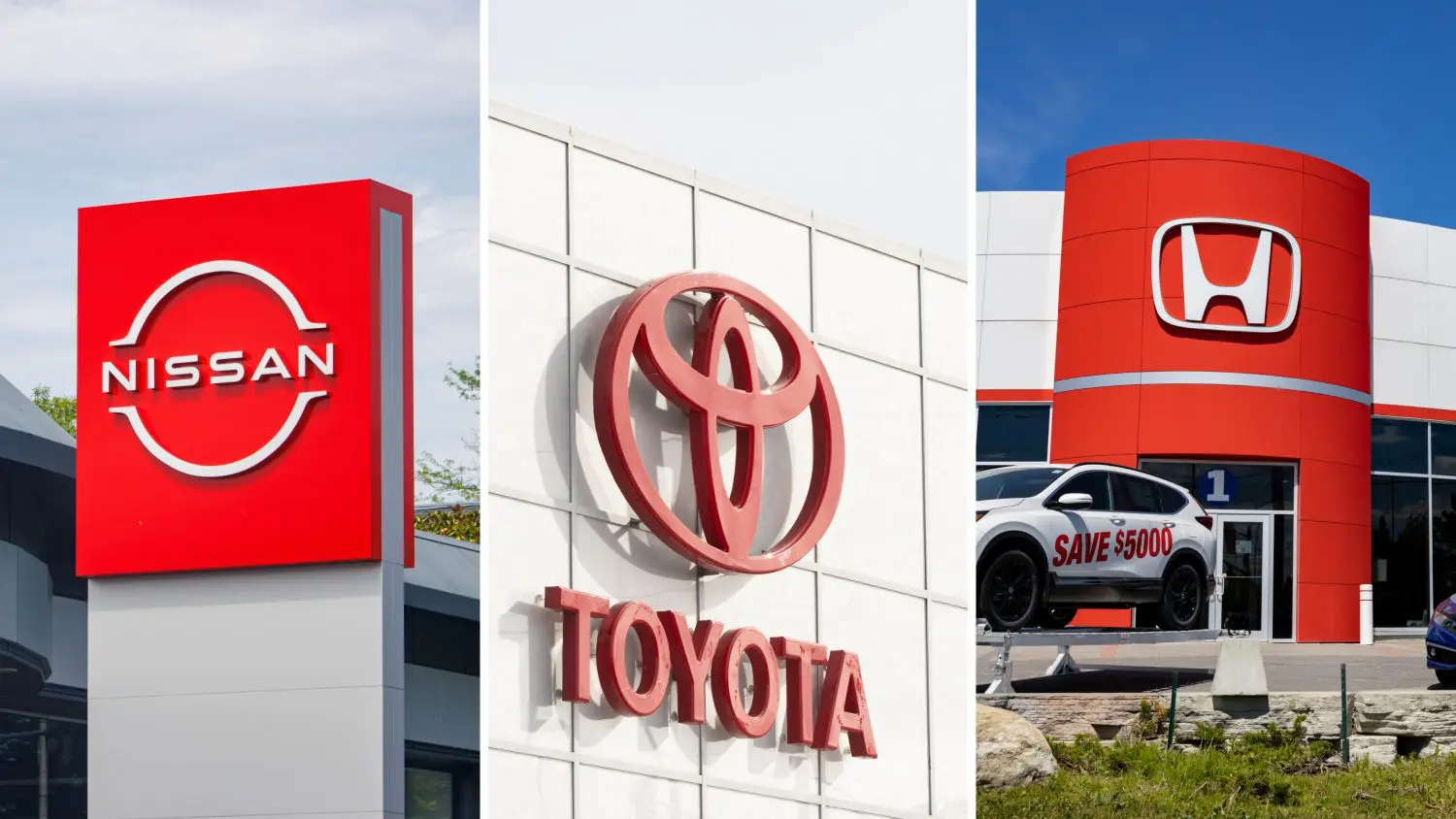
Nissan cites tariffs, supply chain disruptions, and chip shortages, while Toyota and Honda prepare for earnings to come under pressure.
Japanese, chip shortages

On the Dash:

  • Nissan projects an annual loss of $1.8 billion due to tariffs and supply chain pressures, signaling continued market uncertainty.
  • Toyota and Honda expect to report lower profits due to tariffs, rising supply costs, and weakening regional demand.
  • Global chip shortages and trade tensions pose ongoing risks, potentially affecting vehicle production and inventory availability.

Japanese automakers are grappling with a perfect storm of tariffs, rising costs, and supply chain disruptions, with Nissan warning Thursday that it expects an operating loss of 275 billion yen ($1.8 billion) for the fiscal year. The automaker cited persistent risks from U.S. tariffs and ongoing supply constraints, including a shortage of basic chips from Dutch manufacturer Nexperia and trade tensions affecting rare earth magnets critical to electric and hybrid vehicles.

Nissan said the impact of tariffs will be 25 billion yen lower in the second half of the fiscal year due to a U.S.-Japan trade agreement that reduces duties on Japanese vehicles to 15%. Despite mitigation measures, the company cautioned that free cash flow will remain negative for the year. 

Sign up for CBT News’ daily newsletter and get the latest industry stories delivered straight to your inbox.

The company’s first-half operating loss outlook improved sharply to 30 billion yen from a prior estimate of 180 billion yen, aided by lower emissions-related costs and internal savings. However, Nissan has yet to provide a full-year net income forecast due to ongoing uncertainty in component supply and production costs.

Meanwhile, Toyota’s quarterly operating profit is also expected to fall to its lowest level since 2023, pressured by tariffs and rising supply-chain support costs. While U.S. hybrid demand remains a bright spot, domestic sales in Japan have slipped, and management may face questions regarding the planned buyout of Toyota Industries.

Honda faces similar pressures, with earnings expected to decline 15% amid weaker motorcycle sales in Vietnam and slower growth in other Asian markets. Overall, Japanese automakers are navigating a complex landscape of tariffs, a stronger yen, rising costs, and persistent supply chain challenges.

Notably, the broader industry is closely monitoring chip shortages and trade tensions. The Nexperia export halt has affected not only automakers but also machinery manufacturers reliant on semiconductors and rare earth components. Analysts warn that ongoing global supply disruptions could further constrain production and profitability in the months ahead.


Read More
More from Articles
Charlie Obaugh acquires Campus Ford in Virginia

Charlie Obaugh acquires Campus Ford in Virginia

- August 14, 2026
Charlie Obaugh Auto Group has acquired Campus Ford in Waynesboro, Virginia, from Matt McMurray. The transaction was announced in August 2026, with Performance Brokerage Services serving as the exclusive buy-side...
Revised USMCA proposals could cost billions annually, Detroit automakers warn

Revised USMCA proposals could cost billions annually, Detroit automakers warn

- August 14, 2026
On the Dash: USMCA revisions raising U.S. content thresholds to 50% could add at least $2 billion in annual costs per company. GM projects $2.5 billion to $3.5 billion in...
New-vehicle inventory tightens to 75 days' supply as July sales climb 8.5%

New-vehicle inventory tightens to 75 days’ supply as July sales climb 8.5%

- August 14, 2026
On the Dash: New-vehicle inventory drops to 75 days' supply as July sales climb 8.5%. Toyota, Lexus and Honda keep the tightest inventories while Stellantis works through excess stock. ...
Cox Automotive report finds dealers use AI widely, results still lag expectations

Cox Automotive report finds dealers use AI widely, results still lag expectations

- August 14, 2026
On the Dash: Focus AI investments on measurable dealership needs, not adoption for its own sake. Prepare teams for shoppers who are using AI before they reach the showroom. Build...
CBT News
Privacy Overview

This website uses cookies so that we can provide you with the best user experience possible. Cookie information is stored in your browser and performs functions such as recognising you when you return to our website and helping our team to understand which sections of the website you find most interesting and useful.