Welcome back to the latest episode of “The Future of Automotive” on CBT News, where we put recent automotive and mobility news into the context of the broader themes impacting the industry.
I’m Steve Greenfield from Automotive Ventures, and I’m glad that you could join us.
I’m over in China this week, touring Chinese automaker plants and speaking with auto execs. It’s amazing to witness firsthand the speed and scale of the march of the Chinese automakers.
25 years ago, China had almost zero market share of global new car sales. Fast forward to today, and Chinese OEMs make up 40% of all global new car production.
The domestic market here in China for new cars is about 25 million units, but the Chinese have production capacity for about 45 million units. The difference – 20 million units – is being exported.
And the Chinese are moving quickly into any market that doesn’t have prohibitive tariffs.
Chinese market share of new-car sales in Australia has jumped from zero to 40% in 5 years. In Mexico, Chinese automakers now sell about 10% of all new vehicles.
For the time being, the U.S. market is protected with 100% tariffs, which are effectively keeping the Chinese out. But the legacy automakers, GM, Ford, Stellantis, Toyota and Honda, are losing market share in many international markets, as the Chinese continue to export overcapacity in China, and in parallel, set up new production capacity in plants around the world.
The value proposition of the Chinese vehicle is exceptional. Whereas the quality of Chinese new cars 20 years ago was pretty challenging, they now build cars as well (if not better) than any other global automaker, and have figured out how to build cars at a lower price point.
Just like Toyota in the 1960s, having the luxury of reinventing the way that cars were built, the Chinese learned from their JVs with brands like Toyota, Honda and GM, and have been able to design their manufacturing processes and supply chains from the bottom up. The result is very high-quality production while simultaneously achieving dramatic efficiencies and cost reductions across the supply chain and throughout the manufacturing process.
And all of this has happened in a shockingly short amount of time.
The poster child here in China is BYD, the company that Warren Buffett invested in back in 2008, when the company was a contract manufacturer for cell phone batteries.
BYD didn’t produce its first car until 2005, only 20 years ago.
BYD is forecasted to sell 4.5 million vehicles in 2025, and at this pace, it may only take a few more years before it surpasses Toyota as the largest automaker in the world.
What can the legacy automakers do to compete with the Chinese?
They say in business that competition makes everyone stronger. That declaring an enemy brings clarity of focus and motivation of effort.
Legacy automakers like Ford, GM, Toyota and Honda can clearly see that the Chinese have figured out how to innovate faster, build high-quality cars, and do so at a lower cost.
Now it’s time to rise to the challenge of figuring out how to compete with the Chinese at a global scale.
So, with that, let’s transition to Our Companies to Watch.
Every week, we highlight an interesting company in the automotive technology space to keep an eye on. If you read my weekly Intel Report, we showcase a company to watch, and we then take the opportunity here on this segment each week to share that company with you.
Today, our new company to watch is CarGenius.ai.
As more and more of search traffic is going to AI bots like ChatGPT, how is the average dealership going to ensure that their brand, dealership information and inventory are going to get a fair shot at showing up in consumers’ AI search results?
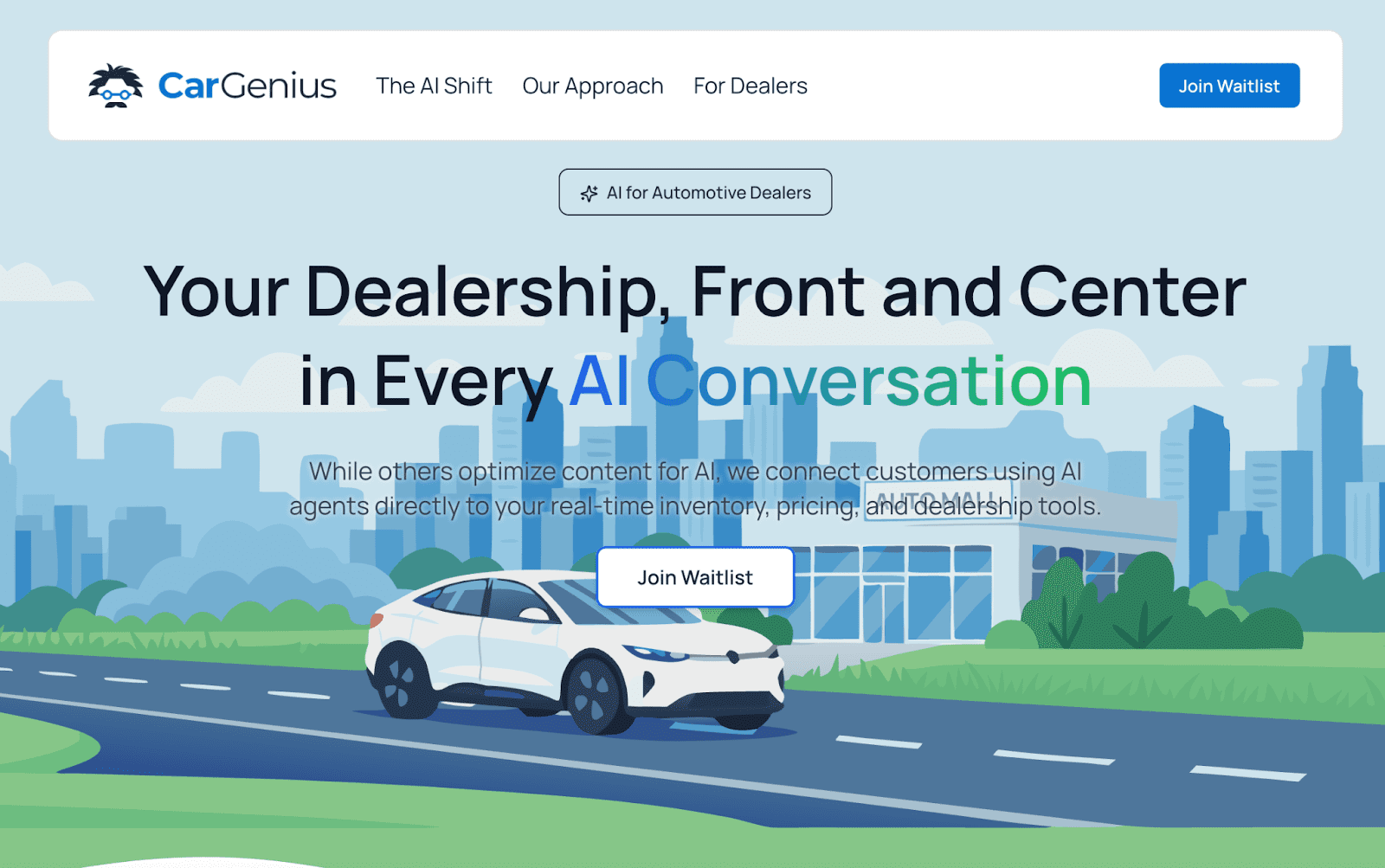
Enter CarGenius, a startup focused on ensuring that your Dealership is kept front and center in every AI conversation.
CarGenius connects customers using AI agents directly to your real-time inventory, pricing, and dealership tools.
If you’d like to learn more about CarGenius, you can check them out at www.CarGenius.ai.
So that’s it for this week’s Future of Automotive segment.
If you’re an entrepreneur looking to solve a big problem anywhere across the Mobility spectrum, we want to hear from you. We are actively investing out of our new Mobility Fund.
Don’t forget to check out my first book, “The Future of Automotive Retail,” and my newest book, “The Future of Mobility”, both of which are available on Amazon.
Thanks (as always) for your ongoing support and for tuning into CBT News for this week’s Future of Automotive segment. We’ll see you next week!