TSLA411.1504.72%
GM84.0702.57%
F14.790-0.05%
RIVN16.680-0.08%
CYD51.8301.8%
HMC26.9700.53%
TM180.2205.27%
CVNA68.9004.8%
PAG180.070-0.89%
LAD308.520-4.86%
AN193.3901.86%
GPI325.7400.41%
ABG199.5500.02%
SAH83.710-0.9%
TSLA411.1504.72%
GM84.0702.57%
F14.790-0.05%
RIVN16.680-0.08%
CYD51.8301.8%
HMC26.9700.53%
TM180.2205.27%
CVNA68.9004.8%
PAG180.070-0.89%
LAD308.520-4.86%
AN193.3901.86%
GPI325.7400.41%
ABG199.5500.02%
SAH83.710-0.9%
TSLA411.1504.72%
GM84.0702.57%
F14.790-0.05%
RIVN16.680-0.08%
CYD51.8301.8%
HMC26.9700.53%
TM180.2205.27%
CVNA68.9004.8%
PAG180.070-0.89%
LAD308.520-4.86%
AN193.3901.86%
GPI325.7400.41%
ABG199.5500.02%
SAH83.710-0.9%

The 2018 Car Shopping Analysis and How Consumers are Adapting to change – Ivan Drury, Analyst with Edmunds.com

With interest rates continuing to stay high, the analysts at Edmunds.com conducted an in-depth review of transaction and finance data across all 50 states. On today’s show, CBT’s Jim Fitzpatrick speaks to Ivan Drury, Senior Manager, Strategic Analytics to get a sense of how consumers are adapting to this changing environment.

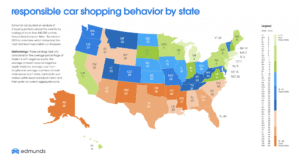
So, what exactly is car shopping responsibility? According to Edmunds.com, the transaction data that stood out was the rate of negative equity among consumers. The share of trade-ins that have negative equity needed to be segmented by state for analysis. The APRs that are being paid, indicate whether consumers have done their research and they got a good deal overall. All of this things together create an understanding of what a responsible car buying journey is.

The motivation for this study began by looking at where are people right now, and how their situation will change going forward? How will an entity like Edmunds.com advise people to make better deals in the future?
edmunds.com
Graphic courtesy of edmunds.com

Well, it turns out that income and education levels were not nearly as important contributing factors when it comes to how well each state performed. It ultimately came down to shopper mentality during car shopping. The states that performed well, had a lot of research on financial calculators, whereas states that did not perform as well had all the flash and glamour, but not the financial substance.

With interests rates on the uptick and negative equity at record high levels, you don’t want consumers to be in a bad situation forever. You have to realize what your financial situation is and work within those means. Trade-in value might not be as high as what you think it is.

Extended terms last longer than the car ownership experience and it certainly plays into the cause of this negative equity. During the examination of all the different metrics for each state, the factors that comprise consumer responsibility were ranked, and a regional trend was not identified.

More from Daily Automotive News
America's savage yards are burning. Drivers are the ones paying the price

America’s salvage yards are burning. Drivers are the ones paying the price

- June 12, 2026
While most Americans see scrapyard fires as local news, the real story may be unfolding in repair shops, insurance offices, and family budgets across the country. Americans don't need another reason...
Stellantis' China gamble could reshape America's auto industry forever

Stellantis’ China gamble could reshape America’s auto industry forever

- June 10, 2026
Americans were told Chinese cars were being kept out of the United States for security reasons. Washington has imposed massive tariffs, politicians promised tougher restrictions, and consumers were reassured that...
Ken Garff Volkswagen

Ken Garff expands Utah footprint with Volkswagen purchase

- June 8, 2026
Ken Garff Automotive Group has acquired Volkswagen SouthTowne in South Jordan, Utah, from Susan Watkins. Announced on June 8, 2026, the transaction marks the group's first acquisition of 2026 and...
China's auto treat: America draws the red line

China’s auto treat: America draws the red line

- June 5, 2026
If you think the debate over Chinese vehicles is about cheaper cars showing up at American dealerships, you’re missing the bigger story—and it’s one policymakers in Washington are no longer...