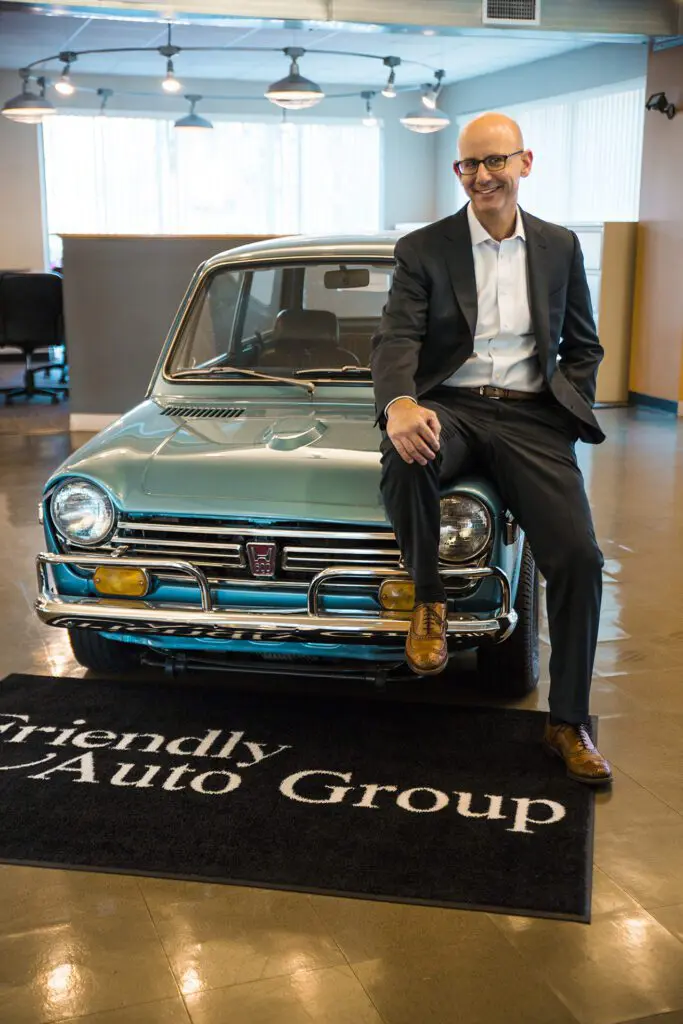
Top Honda Dealer Creates Winning Culture
By: Mary Welch
Eric Kahn is a dye-in-the-wool car guy with a blue stocking education and Wall Street credentials. Or he is a C-suite consultant with flow charts who just loves cars?
Either way, as president and dealer owner of Friendly Auto Group, it’s a combination that has produced a network of incredibly successful dealerships, including being named to the Honda’s elite President’s Award seven times (out of eight) and to edmunds.com’s Five Star Dealers Awards. In 2016, Friendly Honda is ranked 30th in the nation in Certified Used Honda sales out of almost 1,100 dealerships.
He has two main brands. The Friendly Auto Group umbrella covers Friendly Honda House in Poughkeepsie, which he purchased in 2007; Poughkeepsie Ford, acquired in 2012 and Feder’s Acura in Middletown, N.Y. All three were renamed to the Friendly name. In 2006 he bought Keeler Volvo in Albany and renamed it Capital Volvo of Albany and acquired Keeler Jaquar/Land Rover in Albany and renamed it Jaguar Albany/Land Rover and launched Capital Luxury Cars for the Albany-based brands.
With six brands under five rooftops and four locations, he will have an estimated $225 million in sales in 2016 and will sell about 4,000 new and 2,400 used retail units. He has approximately 250 employees.
Growing up in upstate New York, Kahn was a car guy who worked at a dealership doing a little bit of everything. A graduate of Tufts University, he had a nine-month window of time before starting graduate school. So, off he went to an Acura dealership where the twenty-something became one of the top Acura salesmen in the country. “I really enjoyed it and I did very well. I got a taste of the business when I was young.”
He earned a master’s at the Kellogg School of Management at Northwestern University where he majored in marketing, finance and organization behavior. Wall Street beckoned and he went to work for Nomura Securities, a Japanese investment banking firm.
But the lure of the grease tugged at him. “I started reading and seeing some Wall Street people buying dealerships and thought it was kinda interesting,” he remembers. “The possibility of combining my interest and experience in the car business with the knowledge and experience in the finance industry intrigued me.” He went to work with the United Auto Group, which was about to go public, and eventually bought out by the Penske Automotive Group.
He joined the Penske Automotive Group in 1995 and worked in mergers and acquisition as well as operations. Working closely with dealers, consultants and financiers, it became obvious to him that there were not many car-oriented companies to help dealerships either acquire or sell. So he co-founded Bel Air Partners, a Hopewell, N.J.-based consulting firm that provides financial advice and expertise to automotive retailers of all sizes. Since its founding in 1998, Bel Air has advised dealers on transactions nearing $6 billion in terms of retail value.
The lure of the dot.com world captured his attention and he ended up working with an internet start-up, cardata.com, which was backed by major players such as Goldman Sachs and Citi Corp. “It was the eBay of used cars before eBay got into used cars,” he says with a laugh. “It was challenging to make it work.”
After a stint with Potemkin Auto Group, Kahn decided to leave the fancy offices and theoretical talk for the roll-up-your-sleeves life of a dealership owner. He acquired the Volvo dealership from Sandy Keeler and took off from there.
“When we acquire a dealership we always want to keep the people that are currently there,” he says. “There are a number of deals where the seller picked me because, well, they wanted a good valuation, but they also wanted to sell it to someone who potentially they believed would take care of their employees. We try to establish a relationship before closing and access the strengths and weaknesses. Then we make hiring decisions after that assessment.”
Kahn says that his finely honed management philosophy can be summarized by the “5 P’s”: product, place, people, pay plans and promotion (advertising/marketing). There is a sixth P — process.“I see processes as more the responsibility of the general manager than the owner. In fact, some would say that the short job description of a general manager’s job is to install and protect good processes,” he admits.
To be successful you need to recruit top talent who fit into the culture, he says. “At Friendly, we are a customer-focused, performance-oriented culture. Even though it’s a tight labor market, we don’t make it easy to get a job here. We hire people who are passionate about the business who can fit into the culture.”
In fact, Kahn says his biggest mistakes involved personnel. “Over the years I’ve made a few hiring mistakes of key people who looked great on paper and who interviewed well but at the end of the day didn’t fit into the “Friendly” culture. We try to live up to our name with both our customers and employees,” he says.
The culture knows how to get and keep customers. The Friendly Honda store is the highest volume dealership of any brand in the Mid Upper Hudson Valley area. It also consistently is ranked in the top 40 in the country in certified used Hondas and is one of the top selling Honda dealers in the entire Northeast.
Albany is a different market, he says. In fact it may be unique because there is only one luxury dealership per brand. “It’s not a huge market,” he says.
Regardless, it’s obvious the Friendly philosophy is working. “People ask me what makes for a successful dealership,” he says. “and it’s never just one thing. Typically, it’s thousands of little things that make you successful. The different between a good dealership and a great one is consistency. Lots of dealerships do a good job on any given day; not that many do a very good job every day. Consistency is extremely important.”
Another is having an award-winning dealership. “We make it very clear right at the beginning that [the President’s Award] was a top priority goal,” he says. “We also design pay plans so that they are aligned with our goals. Our people are rewarded for winning.”
He also taps into his marketing background and is a “very aggressive marketer who believes in a multimedia approach. I’m out there consistently. I don’t believe in advertising one month and pulling out the next. We’re in the game every day with a very consistent message.”
He is a board member of the TriHonda Advertising Association, which consists of 61 dealers in metro New York, Long Island, parts of New Jersey and the Hudson Valley up to Kingston.
“Dealer Advertising Associations are in vogue today in our industry. I have mixed feelings about them. Having a third brand risks diluting the national and dealer brands, which can muddy the waters for consumers,” he says. “I believe Tier 2 advertising can work well in smaller, insulated markets. However, in associations with large geographies, markets can be so different from each other within the association which makes it challenging for an association to serve every dealer effectively.
Though likes the added dollars being spent on marketing, he “sometimes wonders whether dealers could get a better return on those marketing dollars if deployed differently.”
Friendly’s has some consumer-friendly marketing practices, including being open on Sundays. Used cars are priced on the market rather than professional books. “ We’ve gone with a pricing philosophy in which we use software to see what the market is on the cars that are being offered in our market. We have a wide radius and we make sure our cars are priced competitively relative to cars in our market.”
The market-based pricing eliminates the need for a lot of negotiating because it’s already market friendly, he says. “Everybody wants to feel like they’re getting a good deal. We make sure our customers know they’re getting a good deal; that’s important.”
He offers Friendly rewards on dealership services, such as discounts on maintenance, ding repair and a free car wash, as well as outside perks such as coupons to local restaurants. “It helps in retention, which is important, but maybe even more important is the ability of a dealership to form a relationship and gain trust, particularly in the service department and with the service advisor. That’s really crucial.”
Kahn says he sees more similarities between selling mainstream cars and luxury cars than differences. “The auto retail business is customer-focused on selling $20,000 to $60,000 cars. But really it’s all about providing great buying and servicing experiences and forming relationship with customers. If I see a difference, perhaps it’s in leasing. A see a higher percentage of customers leasing luxury brands than non luxury brands. Leasing is popular across all brands in the Northeast and it’s crucial to have competitive leases. It’s an ongoing issue.”
With five acquisitions in 10 years, Kahn says he’s not looking to expand but isn’t closed to the idea. “To me, geography and market are important. My first choice in looking for a dealership would be in the Hudson Valley where we could leverage the Friendly brand and resources. I look for stores where I can buy the real estate. We typically invest in our facilities. I see real estate may not provide an immediate large return but it can be a long-term investment.”
He looks for dealerships where he can add value. “You know, they’re running OK but maybe not up to their potential. Maybe they’re not as aggressive as they could be. I’m very cautious about major turnarounds, however.”
But right now, he is focused on customer service and deepening the Friendly name and reputation. “We have an excellent reputation in our communities, and at the end of the day, that’s the key.”