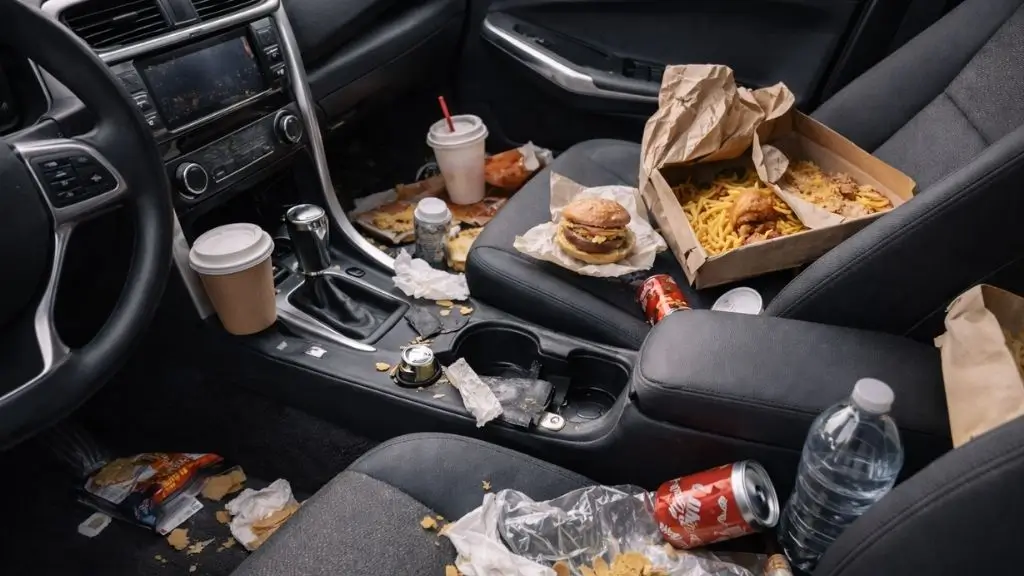
At what point does clutter cross the line from personal inconvenience to a punishable offense? That question is no longer theoretical in Hilton Head, South Carolina, where a new local ordinance allows authorities to fine drivers up to $500—and even impose jail time—for trash inside their own vehicles. What initially sounds like an odd local regulation has sparked a much larger conversation about government authority, vague enforcement standards, and whether similar laws could soon appear in major U.S. cities already struggling with rat infestations.
The ordinance, which went into effect February 1, is intended to combat a growing rodent problem. In public documents, the town places vehicles under the same sanitation rules as buildings, classifying them as potential environments for rats if garbage is allowed to accumulate. The law appears under a section titled “conditions affording food or harborage for rats,” and makes it unlawful to permit trash or rubbish to build up in any building, vehicle, or surrounding area if it may provide food or shelter for rodents.
Violations carry steep penalties. A driver could face fines of up to $500, as well as up to 30 days in jail, or both. Each day the violation continues can be counted as a separate offense, and the town reserves the right to pursue additional legal remedies to correct the issue. While officials frame the rule as a public health measure, its scope and severity have raised eyebrows far beyond South Carolina.
The concern is not simply about cleanliness. It is about how broadly the law is written and how much discretion it gives to enforcement officials. The ordinance does not define what qualifies as “accumulating garbage,” how much trash constitutes a violation, or how an officer is expected to determine whether a vehicle could realistically attract rats. A few empty coffee cups and food wrappers could look very different to different inspectors, leaving drivers unsure where the legal line actually exists.
That ambiguity raises a deeper question: how far does this go? If a local government can regulate the interior condition of a private vehicle in the name of pest control, could other cities follow the same path?
Cities like New York and Los Angeles already struggle with well-documented rat problems. New York City alone has spent tens of millions of dollars annually on rodent mitigation, expanding trash container mandates, increasing sanitation enforcement, and creating entire task forces focused on reducing infestations. Los Angeles has similarly faced complaints about rodents tied to homelessness, open trash, and dense urban living.
In those environments, the temptation to expand enforcement tools is real. Local governments under pressure to show results may look to ordinances like Hilton Head’s as a model, especially if courts uphold them. What begins as a narrowly justified public health rule could evolve into broader regulation of private vehicles, particularly in cities where cars are frequently parked on public streets for extended periods.
That possibility raises serious policy questions. Vehicles are private property, even when parked or driven in public spaces. While governments routinely regulate safety equipment, emissions, and parking behavior, regulating interior cleanliness moves into far less settled legal territory. Once the precedent is established that trash inside a car can constitute a public nuisance, the boundary between public health enforcement and personal autonomy becomes harder to define.
Supporters of such measures argue that extreme cases justify intervention. Vehicles filled with food waste can attract rodents that spread to surrounding neighborhoods, much like unmanaged dumpsters or illegal dumping sites. From that perspective, the ordinance is less about penalizing ordinary drivers and more about preventing genuine health hazards.
Critics counter that the penalties are disproportionate and the standards too subjective. The possibility of jail time for what many consider a quality-of-life issue elevates the matter from civil code enforcement to criminal punishment. Vague laws also increase the risk of inconsistent or selective enforcement, a concern that has surfaced repeatedly in cities with broadly written nuisance ordinances.
There are also unresolved practical questions. Does enforcement require visible trash from outside the vehicle, or could inspections go further? Does a car temporarily parked on a street face the same scrutiny as one abandoned for weeks? The ordinance provides little guidance, leaving these decisions largely to enforcement discretion and, potentially, future court challenges.
Hilton Head’s ordinance may remain an isolated response to a localized problem, or it could mark the beginning of a wider trend as cities search for new tools to manage sanitation and pest control. If similar laws appear in major urban centers, the debate will likely intensify, pitting public health goals against concerns about privacy, due process, and government overreach.
For now, drivers in Hilton Head are the test case. But for motorists elsewhere, particularly in cities already battling rat infestations, the larger lesson is clear. Policies aimed at solving real problems can have unintended consequences, and once the line between public nuisance and private property shifts, it rarely moves back quietly.
Check out my full commentary on this story: https://youtu.be/uH-JIwYBAXE
Looking for more automotive news? https://www.CarCoachReports.com
Listen to The Drive Car Show – https://www.youtube.com/@thedrivecarshow