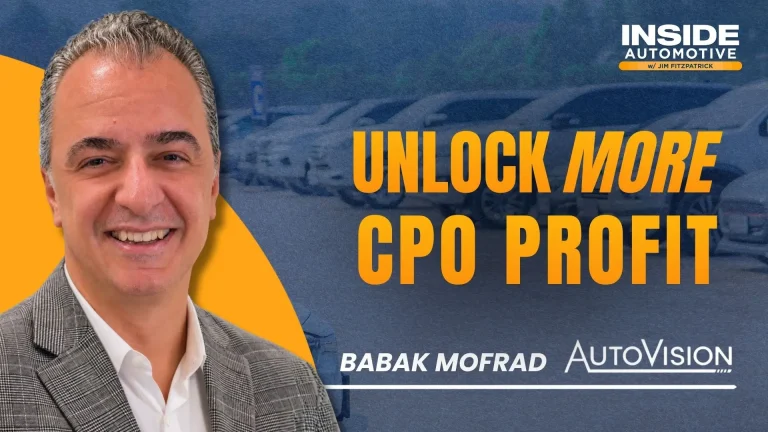
Certified pre-owned (CPO) vehicles could be a bigger opportunity for dealerships, but many aren’t promoting them enough. With consumers watching their budgets and holding onto vehicles longer, Babak Mofrad, President of AutoVision, believes dealers have an opportunity to make CPO a more important part of their used-vehicle strategy.
Speaking on the latest episode of Inside Automotive, ahead of Used Car Week, Mofrad said CPO sales account for less than 2% of all used-vehicle sales, based on his estimate. Yet he sees plenty of room for growth, particularly among franchise dealers that haven’t prioritized it. But getting there means doing a better job of explaining what the program offers, since, as Mofrad said, many consumers still don’t understand the benefits, and dealerships aren’t consistently promoting them on their websites or in advertising. Additionally, Mofrad laid out why he sees branding, reconditioning, and smarter use of technology as the keys to unlocking that growth, and previewed a panel he will lead with three dealers at the event.
Why CPO deserves a closer look
Since Mofid said consumers are stretching to cover higher parts prices, labor costs and gas prices, a CPO vehicle backed by the dealer and the manufacturer can spare them the maintenance surprises that come with rolling the dice on a non-CPO car. He knows the feeling firsthand, having extended his wife’s lease by six months because interest rates were too high. With about 18,000 franchise dealers in the country, he sees “lots of opportunity for growth.” But getting there starts with branding, he said, noting that “consumers are confused about what CPO may be” and that dealers aren’t always doing their best job of explaining the benefits on their websites and in their advertising.
“If a franchise dealer is not currently utilizing CPO as a strategy or it's not at top of mind, like, they really should look at that more closely.”
The other piece is reconditioning, where Mofrad said CPO vehicles come with manufacturer rules that push costs higher, so when a car “sits stagnant” without the right processes in place, dealers “just continue to lose money.” Therefore, he says a solid reconditioning plan is the fastest way to get CPO inventory through the shop and onto the lot.
Although finding the right inventory is another hurdle, Mofrad said “the acquisition piece continues to be a challenge for a lot of the dealers” he has met, and with auction prices still high, more of them are chasing private-party purchases and building service drive buys into their process. The wrong purchase, he cautioned, can quickly turn into an aged unit that eats into profit.
How technology can close the gaps
According to Mofrad, technology connects those pieces. Since AutoVision joined Reynolds, its integration with the DMS, CRM, inventory management and reconditioning tools has enabled dealers to appraise a vehicle from a CRM lead, add it to inventory with a stock number and open a repair order for reconditioning, an all-in-one seamless flow. He also said dealers should look beyond market day supply and days on market, considering measures such as how long a vehicle has been advertised, how quickly it could sell and its percent to market.
Additionally, Mofrad believes most AutoVision dealers are averaging $400 to $500 more in gross per vehicle and turning inventory 1.7 days faster, based on six months of DMS activity visible through Reynolds, which backs the company’s pitch to “gross higher and turn faster.” The bigger challenge, he said, is translating all that data so dealers aren’t left guessing what it means.
Looking ahead, Mofrad said AutoVision built its AI agent, Avery, in 2024 and launched it at NADA 2025. Avery now provides pricing and stocking recommendations, while the RAY agent works to unify software across the Reynolds platform. He described the company’s focus as shifting from integration and automation to what he called unification. Still, Mofrad hopes dealers leave Used Car Week with a fresh perspective on technology, comparing the risk of overlooking new technology to Yahoo ignoring Google, and warning that a store can fall behind without noticing until the effects catch up. He also urged dealers to revisit the tools they already use, noting they “may not need everything that they signed up for 10 years ago.”