TSLA386.750-22.2%
GM81.970-1.8%
F14.565-0.435%
RIVN15.335-1.505%
CYD52.600-3.96%
HMC26.500-0.47%
TM175.500-2.95%
CVNA67.875-1.575%
PAG176.0003.51%
LAD300.2608.31%
AN192.7156.885%
GPI327.61010.96%
ABG198.4504.99%
SAH83.8601.17%
TSLA386.750-22.2%
GM81.970-1.8%
F14.565-0.435%
RIVN15.335-1.505%
CYD52.600-3.96%
HMC26.500-0.47%
TM175.500-2.95%
CVNA67.875-1.575%
PAG176.0003.51%
LAD300.2608.31%
AN192.7156.885%
GPI327.61010.96%
ABG198.4504.99%
SAH83.8601.17%
TSLA386.750-22.2%
GM81.970-1.8%
F14.565-0.435%
RIVN15.335-1.505%
CYD52.600-3.96%
HMC26.500-0.47%
TM175.500-2.95%
CVNA67.875-1.575%
PAG176.0003.51%
LAD300.2608.31%
AN192.7156.885%
GPI327.61010.96%
ABG198.4504.99%
SAH83.8601.17%

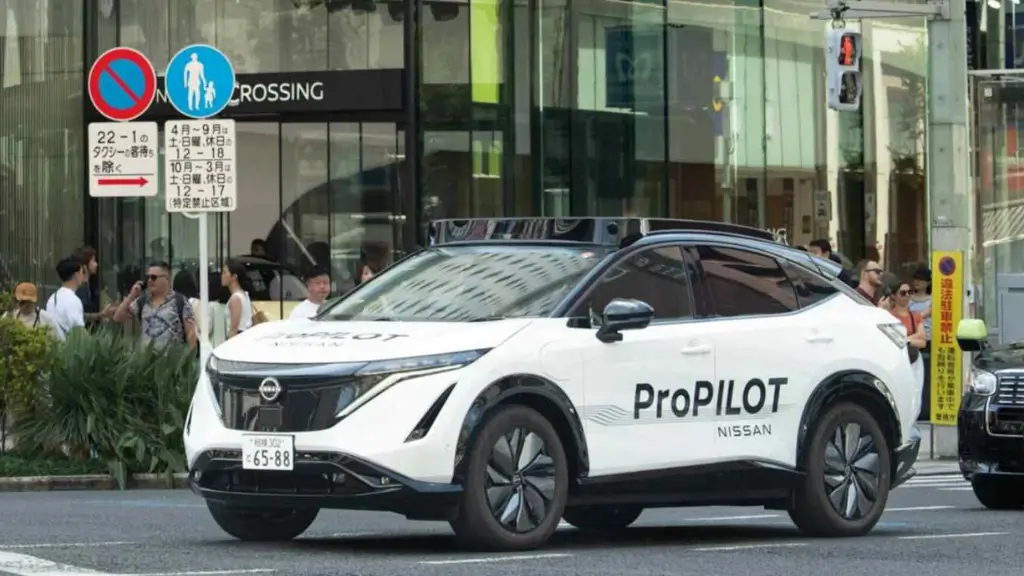
Nissan, Uber to deploy autonomous ride-hailing vehicles by 2027

The partnership would integrate Wayve’s AI-driven self-driving technology into Nissan vehicles for global ride-hailing services beginning in fiscal 2027.

Nissan, Uber in final talks to deploy autonomous ride-hailing vehicles by 2027

Image Source | Nikkei Asia

On the Dash:

  • Nissan plans to introduce hands-free urban autonomous driving technology in production vehicles by fiscal 2027.
  • The next-generation ProPilot system integrating Wayve AI is expected to expand assisted driving capabilities beyond current Level 2 technology.
  • Partnerships in autonomous ride-hailing could enhance Nissan’s brand visibility while accelerating industry investments in self-driving vehicles.

Nissan is in final talks with Uber Technologies to deploy autonomous vehicles for global ride-hailing services, using self-driving technology the automaker is developing with U.K.-based Wayve Technologies, Nikkei Asia reported Monday.

The partnership aims to deliver production vehicles in fiscal 2027 that feature hands-free, autonomous driving capable of navigating urban environments. Uber plans to offer the service in Japan and overseas within the next few years.

Sign up for CBT News’ daily newsletter and get the latest industry stories delivered straight to your inbox. 

Wayve specializes in end-to-end autonomous technology, where AI manages perception and decision-making by analyzing footage from onboard cameras. The system uses neural networks trained on real-world fleet data and simulations, allowing it to operate in complex traffic without relying on high-definition maps or pre-coded rules. The platform is modeled on Tesla’s supervised Full Self-Driving system, with no geographic restrictions.

Nissan’s current technology is Level 2, requiring drivers to take control in certain situations. The automaker is working toward fully driverless Level 5 operation. Its next-generation ProPilot system, integrating Wayve AI software, is expected to launch in Japan and North America by early 2028. 

The technology will be compatible with several Nissan utility models, including the Armada, Pathfinder, and Rogue, the company’s U.S. volume leader.

The discussion addresses Nissan’s declining sales in key markets and its attempt to leverage its partnership with Uber to boost brand momentum. Meanwhile, Uber is furthering its autonomous ride-hailing expansion by collaborating with other automakers, with plans to deploy over 20,000 Lucid vehicles integrated with Nuro’s self-driving technology within the next six years.

More from EVs & Technology
Ford-backed group urges EU to delay EV import tariffs

Ford-backed group urges EU to delay EV import tariffs

- June 8, 2026
On the Dash: A Ford-backed group is urging the EU to delay EV import tariffs, citing battery supply chains that aren't ready. EU and UK battery production is far...
JPMorgan boosts Tesla price target to $475

JPMorgan boosts Tesla price target to $475, citing autonomous tech and software growth

- June 5, 2026
On the Dash: JPMorgan sees Tesla's future growth extending beyond vehicle sales and increasingly tied to software, AI and autonomous driving. The firm's $475 price target reflects growing Wall Street...
World's largest battery maker shifting away from EVs to energy storage

World’s largest battery maker shifts away from EVs to energy storage

- June 5, 2026
On the Dash: CATL wants energy storage to account for half of its global sales by 2030, up from 25% today. Automakers and dealers could face tighter EV battery supply...
Auto industry warns AI chip demand could disrupt manufacturing

Auto industry warns AI chip demand could disrupt manufacturing

- June 4, 2026
On the Dash: AI-driven demand for memory chips could increase vehicle production costs and create new supply chain disruptions. Industry groups warn that rising chip prices may eventually translate into...